In this episode, we’re stepping into a new section of the 119 Bible Bootcamp—Gathering Our Gear. We’ll take a closer look at the different kinds of Bible translations, why there are so many, and how each one can help you connect with God’s Word in your everyday life. If you’ve ever felt confused by all the options, this is your invitation to breathe easy and find the tools that work for you.

- Why new Bible translations exist and how language shapes our understanding of Scripture
- The three main types of English Bible translations—and how they differ
- How Psalm 119:130 sounds in different translations and what that means for you
- Permission to try more than one translation, depending on your needs
- A visual guide to translations included in the free Companion Kit


- Listen on the Podcast
- Watch on YouTube

Hey there friend, and welcome. I’m so glad you’re here—like, really a lot.
If you’ve ever found yourself scrolling through Bible apps or searching online, feeling a little lost among all the options, you’re in good company!
Today, we’re beginning a new section of the 119 Bible Bootcamp. In the last few episodes, we spent time mapping the terrain—getting familiar with the basics of the Bible. Now, we’re moving on to Gathering Our Gear—and there’s no tool more essential (of course) than the Bible itself.
But with so many translations out there, how do you know which one is “right” for you?
In this episode, we’ll explore the different types of Bible translations, why there are so many, what sets them apart, and how you can choose the ones that fit your reading and study needs.
Here’s a little secret: the translation you read for understanding might not be the same one you reach for when you want to dig deeper. I keep a few favorites on hand, and it’s not unusual for me to have two or three translations open whenever I settle in with Scripture.
Why So Many Translations of the Bible?
We are blessed to have access to so many translations of the Bible. Originally, the Old Testament was written mostly in Hebrew, with a little bit of Aramaic, and the New Testament was written in Greek. Since those original scripts, translators have spent centuries working to update those ancient words into languages we can understand.
The challenge, language is always changing! The words, phrases, and idioms that made sense hundreds of years ago might hold completely different meanings today.
Those who first penned Scripture lived in a world with different customs, different cultures, and different ways of speaking.
So, reading the King James Version can feel a bit like reading Shakespeare, while some modern versions are more like texting a friend—same language, but completely different vibe!
That’s why new translations keep appearing—to help us hear God’s Word in ways that actually make sense for our lives today.
The Three Main Types of Bible Translations
If you imagine all the different English Bibles lined up as tools in your spiritual backpack, you’ll find three main kinds—each with a unique way of helping you understand God’s Word.
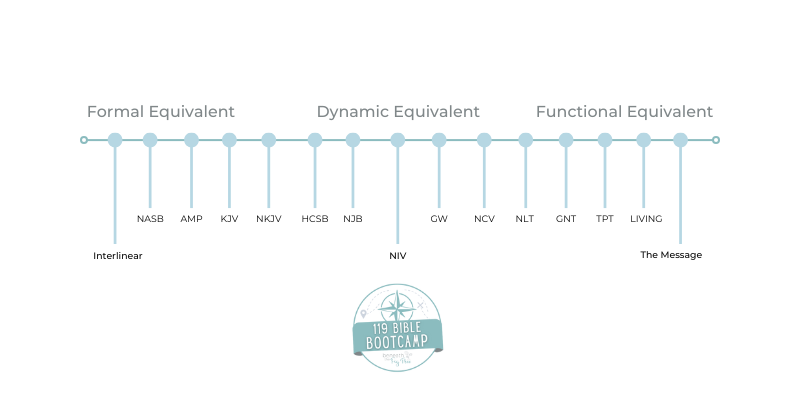
(And if you’d like to see how this all lines up visually, I’ve included a simple guide in the downloadable companion kit!)
Formal Equivalent (Word-for-Word)
This approach aims to stay as close as possible to the original Hebrew or Greek words and sentence structure.
- Examples: KJV, NKJV, ESV, NASB, Amplified
- These translations are wonderful for digging deep and studying Scripture closely, but the language can feel a little formal or old-fashioned for everyday reading.
Functional Equivalent (Thought-for-Thought, Including Paraphrase)
This type focuses more on the thoughts or intentions behind the original words—rephrasing them so they make sense in our current language and culture.
- Examples: The Message, The Living Bible, The Passion Translation (TPT)
- These translations are much easier to read and can make the message feel brand new, but they take more creative liberty and are best for devotional reading or seeing Scripture from a fresh angle.
Dynamic Equivalent (The Middle Ground)
Dynamic translations try to balance both ends—holding as closely as possible to the original text but also making sure it reads smoothly and naturally for today’s reader.
- Examples: NIV, HCSB, NAB
- You’ll find these are a great blend: accurate, clear, and comfortable for everyday reading and study.
No translation is perfect— some words, ideas, and cultural references just don’t have an exact equivalent in our language.
How Do I Choose?
With hundreds of options, how do you pick? First, let’s let go of the pressure to get it “right.” There’s no one-size-fits-all answer! Some people like a formal translation for in-depth study. Others prefer a dynamic or paraphrased version that speaks right to the heart.
To make it even more complicated, there are a lot of strong opinions about the different translations influenced by theological, doctrinal, and event denominational differences. We won’t address any of those here and I’m not going to recommend one translation over another because I think that’s a personal choice.

Examples from Psalm 119:130
Let’s pause with one verse—Psalm 119:130—and listen for the ways each translation invites us in, using its own wording and style.
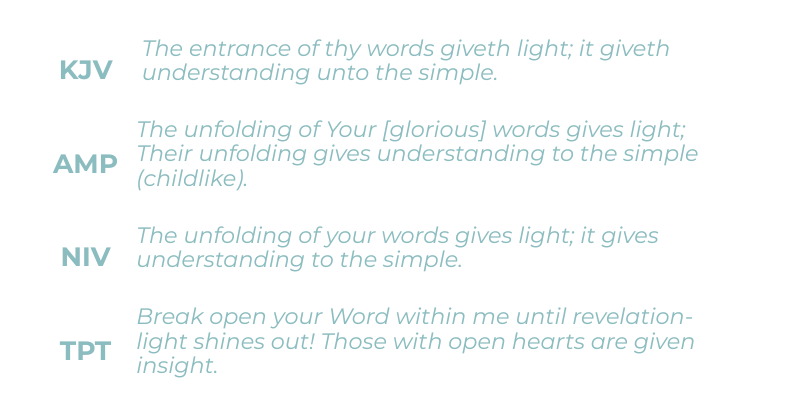
King James Version (Formal Equivalent):
“The entrance of thy words giveth light; it giveth understanding unto the simple.”
This classic translation is close to the original wording. You’ll notice phrases like “thy” and “giveth”—words we don’t really use anymore. But there’s a certain beauty in its formality and poetry. “The entrance of thy words” paints a picture of God’s Word as a doorway, opening into light and understanding. And “the simple” refers to those who are teachable or humble.
Amplified Bible (Formal Equivalent, Expanded):
“The unfolding of Your [glorious] words gives light; Their unfolding gives understanding to the simple (childlike).”
The Amplified adds clarifying words in brackets, unpacking what “simple” means: “childlike.” Here, “unfolding” suggests God’s Word is like a scroll, slowly revealing truth layer by layer. This version helps fill in the meaning for modern readers, offering a little more context with each phrase.
New International Version (Dynamic Equivalent):
“The unfolding of your words gives light; it gives understanding to the simple.”
The NIV keeps things clear and straightforward, using modern, everyday language but still staying close to the structure of the original. “Unfolding” shows up again—reminding us that Scripture is something to open up and explore, not just read once and put away.
The Passion Translation (Functional/Paraphrase):
“Break open your Word within me until revelation-light shines out! Those with open hearts are given insight.
Here, the language is much more expressive and personal: “break open your Word within me.” It invites you to picture God’s Word like a seed or a treasure chest, ready to burst open with light from the inside out. The focus shifts to “open hearts” instead of “the simple,” showing how a posture of willingness leads to understanding.
Notice how each translation opens a slightly different window:
- Some use “simple,” others “childlike” or “open hearts.”
- Some emphasize “entrance,” “unfolding,” or “break open”—all different ways to describe how God’s Word becomes real to us.
- The more formal translations feel steady and rooted; the more functional ones feel immediate and personal.
Each translation offers its own invitation into the verse, and sometimes, reading more than one can help you see a passage with new eyes. The treasure, though, is always the same: God longs to bring us light and understanding, no matter which translation you pick up.
Choosing a Translation: Which One Is Right for You?
So with all these differences, how do you decide which Bible translation—or translations—are right for you?
Here’s some permission right up front:
You don’t have to pick just one. Many people find it helpful to keep two or three translations on hand—a more literal one for deeper study, and a more conversational one for devotional reading or prayer.
A few simple questions to help you decide:
- Which translation feels comfortable to read out loud?
- Is there a version that helps you actually want to keep reading?
- When you read a verse and it finally “clicks,” which translation was it?
- Are you looking for something that’s easy for everyday reading, or do you want to dig into the details and original context?
Some days, you might want the steady language of a word-for-word translation. Other days, you might reach for something that speaks right to your heart, in your everyday language.
And remember: If you ever have questions or concerns about a particular translation, that’s a great time to reach out to your pastor, a trusted friend, or someone further along on the journey. God often brings wisdom through community.
At the end of the day, the best Bible for you is the one you will actually open, read, and let shape your life. There’s no single “right” choice—only the next right step for where you are right now.
Invitation to the Companion Kit
If you’d like to dig deeper, see that translation guide, or reflect with some gentle prompts, don’t forget to grab the free Companion Kit. It’s packed with simple tools to help you feel at home with your Bible, no matter which translation you’re exploring.
Friend, wherever you are on your Bible journey—whether you’re flipping pages in a well-worn translation or scrolling through something brand new—remember this: God’s heart isn’t for you to master a particular version, but to discover more of Him.
You don’t have to have it all figured out. Give yourself permission to try different translations, to listen for what helps you see God more clearly, and to trust that He delights in every step you take toward Him.
If this episode encouraged you, consider sharing it with a friend or leaving a review. Every share helps more women discover the treasure waiting in God’s Word.
Let’s keep cultivating a devotional life you love—like, really love. Because it is possible—and it’s often simpler than we think.
And remember: there’s no such thing as “behind” here. Just your next yes.